
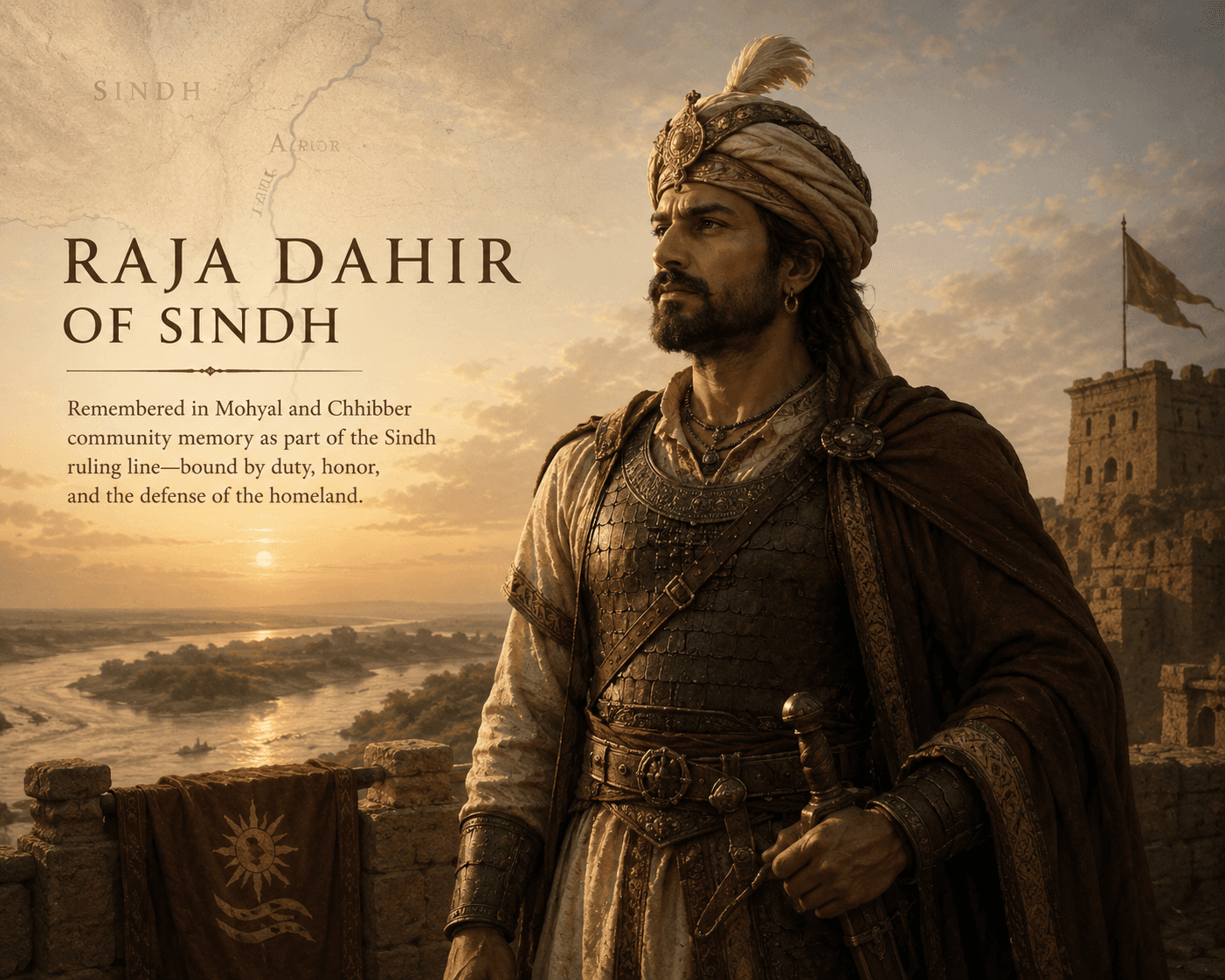
01
Sindh Before the Fall
Before the conquest, Sindh was not merely a frontier to be crossed. It was a world in its own right: river kingdoms, market towns, temple centers, fortified routes, and agricultural settlements held together by the Indus and by the long traffic of exchange that moved between India, Persia, and Central Asia. Caravans, sailors, tax officials, Brahmin administrators, soldiers, merchants, and local chiefs all belonged to that landscape.
To speak of Sindh in the late seventh and early eighth centuries is to speak of a threshold region. It faced west without ceasing to be rooted eastward. It absorbed travelers and pressures from many directions. It was exposed to trade, to coastal danger, to imperial ambition, and to the constant burden of governing a zone where commerce and conflict so often met.
Within that geography, the kingdom of Aror stood as one of the important political centers. Power there was not abstract. It meant managing routes, revenue, local alliances, and the difficult obligations of frontier governance. The ruler of Sindh did not merely reign over a settled interior. He stood in a corridor where worlds touched and where the next era was already pressing against the old one.
02
Who Raja Dahir Was
Raja Dahir ruled Sindh in the late seventh and early eighth century and is generally associated with the Brahmin dynasty that governed the region before the Arab conquest. In later memory, he appears not only as a king but as a figure standing at the edge of historical transition, trying to hold together a realm during a period of deep instability.
The political atmosphere around him was already unsettled. Maritime insecurity, accusations of piracy, disputes tied to trade, local rivalries, and the expanding strategic ambitions of the Umayyad world all formed part of the environment in which he governed. Sindh was not attacked in a vacuum. It stood at the meeting point of commercial grievance, frontier politics, and imperial momentum.
That context matters because it restores Raja Dahir to history rather than legend. He was not simply an isolated tragic hero waiting for invasion. He was a ruler operating under pressure in a region whose value was understood by both local powers and expanding empires.
03
The Invasion of Sindh
When Muhammad bin Qasim's campaign entered Sindh, it did so with the force of a larger imperial system behind it. Whatever local calculations may have preceded the conflict, the military imbalance was real. The campaign was organized, sustained, and directed toward irreversible political change.
Raja Dahir resisted that campaign, and the end came near the Indus in 712 CE. Accounts differ in detail across traditions and later retellings, but the broad historical outcome is well known: Dahir was defeated and killed, and the old order of Sindh gave way to a new phase in the region's history under Arab rule.
The importance of that defeat lies not only in who fell on the field, but in what ended with him. A kingdom did not simply lose a battle. Administrative patterns, political loyalties, and civilizational orientation were all altered by the conquest. That is why Raja Dahir remained in memory. His death marked more than personal loss. It marked the collapse of a horizon.
04
How Mohyal and Chhibber Memory Remembered Him
Within some Mohyal and Chhibber traditions, Raja Dahir did not disappear when the kingdom disappeared. His name continued to live in community retelling, preserved through oral memory, clan narratives, and regional identity. In these traditions, he is remembered as connected to older lines of governance, responsibility, and frontier duty associated with Sindh and later Chhibber memory.
Mohyals.com presents that connection carefully. Historical details about Raja Dahir's rule and the Arab conquest of Sindh are widely documented across broader historical writing. But the more specific Mohyal and Chhibber lineage associations belong primarily to inherited community memory: they are remembered in some Mohyal accounts, preserved through family and regional retelling, and carried forward because they felt meaningful to those who repeated them.
That distinction does not weaken the story. It tells us what kind of story it is. It is not valuable because every genealogical strand can be flattened into a single universal proof. It is valuable because a community continued to hold the name close, linking it to its own moral and historical imagination.
Raja Dahir endured in memory not because he won, but because communities remembered him as someone who stood his ground during a civilizational turning point.
05
Frontier Duty, Defeat, and the Meaning of Endurance
The figure of Raja Dahir survives most powerfully when read through themes larger than dynastic succession. He belongs to the language of frontier duty: the responsibility of holding a threshold, governing a vulnerable edge, and remaining in place when the surrounding balance of power is turning against you.
That is one reason later community memory could keep returning to him. Defeat does not always erase significance. Sometimes it concentrates it. A political collapse can become a moral marker when later generations interpret it through courage, responsibility, and the refusal to abandon post before the age itself has shifted.
In Mohyal and Chhibber memory, this is part of the larger grammar of inherited identity. A remembered figure matters not only because he founded or ruled, but because he embodies a quality later generations wished to admire: steadiness in the face of historical pressure. The story remains because it speaks to a community ethic in which collapse does not cancel dignity.
That ethic is especially resonant for a community that has long understood itself through service, administration, learning, and martial responsibility held together rather than divided. The deeper memory is not triumphal. It is disciplined. It says that moral seriousness can outlive political survival.
06
After Kingdoms, After Partition
The name of Raja Dahir also traveled forward into a world he could never have imagined. Long after Sindh's kingdoms had disappeared, Mohyal families themselves underwent historical dislocation. Partition emptied old homes, broke districts apart, and transformed inherited geography into refugee memory. Families crossed into Delhi, Punjab, Jammu, and later into the wider diaspora.
Yet names endured. So did the older figures through whom communities interpreted themselves. That is part of the emotional bridge between Sindh and Partition memory. The kingdom did not survive. Many later households did not remain where they had been for generations. But remembrance survived. That is often how heritage actually moves through history: not as uninterrupted sovereignty, but as a continuity of names, stories, and moral reference points carried across upheaval.
For Mohyal families, especially those tracing Chhibber memory through Sindh, Pothohar, Punjab, and later migration, Raja Dahir could remain meaningful precisely because he belonged to an older chapter of loss followed by endurance. He stood at the end of an era. Many later families felt, in their own smaller way, what it meant to live after such endings.
07
Why the Name Stayed
A community does not keep every old ruler alive in speech. Most names recede into the background of time. The names that remain are usually those that answer a continuing need. Raja Dahir remained in Mohyal and Chhibber memory because he answered one of the oldest questions a displaced or historically conscious community can ask: what does it mean to stand in place when the age itself is moving away from you?
The answer preserved in memory is not one of crude revenge or loud civilizational grievance. It is quieter than that, and perhaps stronger. It is the belief that standing one's ground in history has meaning even when the immediate outcome is defeat. It is the belief that inherited dignity does not vanish simply because power changes hands. It is the belief that memory itself can become a form of continuity after structures of rule have collapsed.
And so Raja Dahir remains less as a monument to victory than as part of a remembered moral landscape. Heritage survives through stories, names, and figures that communities decide are still worth carrying. Across generations, that is how a kingdom can vanish and yet not disappear entirely from human meaning.
Community Memory & Historical Context
Raja Dahir's place in the history of Sindh and the Arab conquest period is widely documented across broader historical writing. The more specific Mohyal and Chhibber lineage associations, however, belong primarily to community tradition and inherited memory, preserved through oral retelling, clan narrative, and regional historical imagination.
Read this feature alongside the Chhibber clan archive, the Mohyal archives, and the wider Heroes & Martyrs collection.
Related
Related clan
Chhibber clan archive
Explore the Chhibber living archive through Sindh memory, Karyala, Sikh-era service, and migration records.
Related place
Remembered places in the archive
Move from Sindh memory into later Punjabi geographies, regional transition, and the place archives preserved on Mohyals.com.
Related archive
Mohyal archives
Follow this story outward into clan records, historical writing, and the 1938 archive that preserved older community memory.
Related community memory
Heroes & Martyrs
Read other remembered figures whose names survived because communities carried them forward with moral seriousness.