
01
Karbala
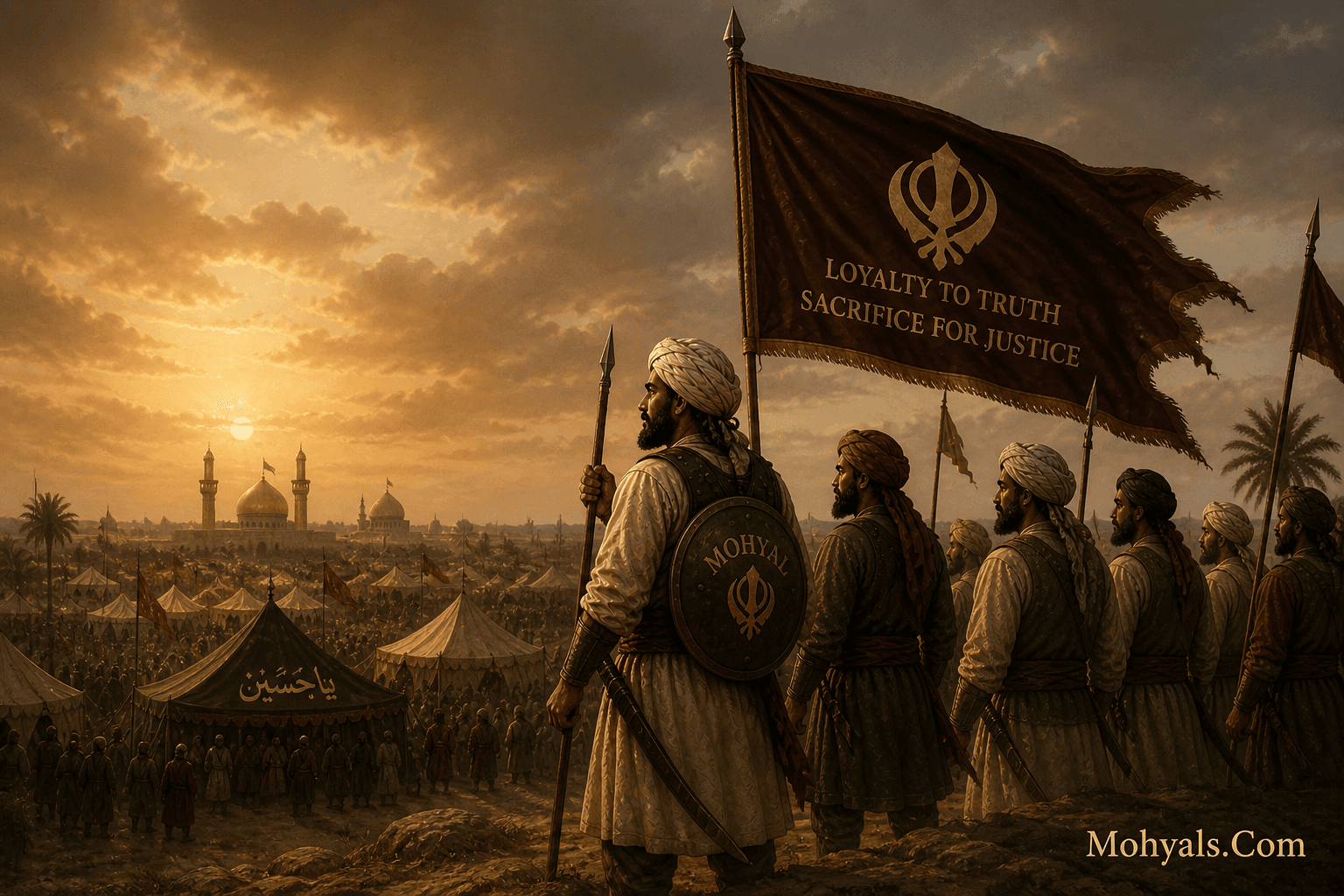
The story begins in a landscape stripped down to first principles: sand, heat, distance, and thirst. Karbala was not a place of concealment. It offered no forest cover, no mountain refuge, no strategic advantage for a smaller force hoping to survive by cleverness. It was a plain where power could surround conscience in full view of the sky.
By the time Husayn ibn Ali and the small camp around him reached that ground, the shape of the end was already visible. The Euphrates flowed nearby, but access to water was constricted. Children were thirsty. Tents stood under pressure from an army whose numbers made the imbalance undeniable. Those who remained with Husayn knew the arithmetic. They also knew that the question before them was no longer how to win, but how to remain true when victory in the ordinary political sense had become almost impossible.
That is one reason Karbala has endured so deeply across Muslim memory. The event is not remembered only for battle. It is remembered for moral clarity under siege. A camp was made smaller by desert, thirst, and encirclement, yet larger by the refusal to surrender its inner ground. The physical situation narrowed. The ethical horizon widened.
02
Why Karbala Mattered
The immediate historical crisis was the demand for allegiance to Yazid. Husayn refused that demand, not as a theatrical gesture but as a matter of principle. For many who remember Karbala, that refusal marks the difference between merely surviving power and bearing witness against what one cannot in good conscience legitimize.
The journey toward Kufa followed hopes of support, invitation, and political realignment. But the route did not end in safety. Husayn and his companions were intercepted and brought to Karbala, where a vastly larger force confronted a much smaller camp. What followed has been preserved in Sunni and Shia traditions with different emphases, but with a shared understanding of gravity: Husayn and his companions were killed, and the event became one of the great moral wounds of Islamic history.
This is why Karbala did not remain confined to one century. It became a permanent moral reference point. People returned to it not only to recall who died there, but to ask what fidelity requires when power and justice part ways.
03
How Mohyal Memory Entered the Story
Within Mohyal community memory, especially among many Dutt families, Karbala never remained distant. Across generations, Mohyal oral tradition preserved the belief that men of the Dutt clan stood with Husayn. In that inherited memory, the central name is Rahib Sidh Dutt, also remembered as Rahab Sidh Dutt or Rahib Siddha Datt, a warrior figure said to have sacrificed his seven sons in that struggle.
For Mohyals.com, the significance of this tradition lies not in forcing every detail into a modern courtroom standard of proof, nor in dismissing it because it traveled through families before it traveled through institutions. The Mohyal connection to Karbala survives in oral retellings, community writing, inherited family identity, and the long moral language of the Hussaini Brahmin tradition. It has lived because people continued to tell it, and because they believed it said something essential about who they were.
That difference matters. Communities do not preserve every story with equal force. Some accounts fade because they no longer speak to the present. Karbala survived in Mohyal memory because it did the opposite. It stayed close to the conscience of the community.
Mohyals did not preserve this story because they gained power from it. They preserved it because it reflected the kind of people they believed they should be.
04
Why the Story Endured
The deeper question is not simply whether the story was told. It is why it was told and retold for so long. Mohyal families preserved Karbala because it offered a moral mirror. In that mirror, they saw not conquest, not reward, and not tribal triumph, but the older and harder virtues of dharma: to recognize the just side, to remain loyal when the cost is high, and to understand that defeat in the field may still be victory in the realm that matters most.
This is one of the places where Mohyal memory and the wider civilizational language of the subcontinent meet naturally. In the Mahabharata, the measure of action is not only success but righteousness. The question is not merely who prevails, but what one was willing to stand beside. That is why Karbala could be carried in Punjabi Hindu memory without becoming foreign. It resonated with ideas already familiar: duty above safety, witness above convenience, and the conviction that where there is dharma, there is victory, even if the battlefield appears to say otherwise.
The comparison is not meant to flatten traditions into one another. Karbala remains distinctly itself, with its own theological and devotional place in Islam. Yet Mohyal families often heard it through moral patterns they already understood. In that sense, some remembered Husayn through the language of righteous refusal. Some remembered the fallen through echoes of Abhimanyu: a young warrior surrounded, the odds impossible, yet the willingness to fight on remaining itself a form of truth.
That is also where the self-understanding of Mohyals as scholar-warriors enters the page. The community has long described itself not as martial for its own sake, but as shaped by both learning and action. Karbala fit that self-image because it was not merely a story of fighting. It was a story about knowing what side one must stand on even when history offers no guarantee of worldly success.
05
Moral Victory
Political victory settles a throne. Moral victory settles memory. Karbala belongs to the second category. That is why its emotional reach far exceeded the military scale of the event. A small camp on a desert plain became one of the largest moral landmarks in the world because those who died there made visible a truth that later generations could still inhabit: there are moments when losing power is less significant than refusing to lose principle.
Mohyal community memory preserved the Dutt connection in exactly that register. The story was not repeated because it gave Mohyals dominion. It gave them orientation. It said that the right side of history is not always the stronger side in the moment. It said that courage without moral direction is empty. It said that lineage is judged not only by ancestry, but by the causes one chooses to honor.
Seen this way, Karbala became part of an ethical inheritance. It entered households not as an exotic episode, but as a statement about what a people ought to admire. The memory of Rahib Sidh Dutt and his sons mattered because it translated an immense historical sorrow into a recognizable family virtue: stand beside the just, even when the cost is unbearable.
Heritage survives not only through bloodlines, but through the stories communities refuse to abandon.
06
After Punjab, After Partition
The durability of the Karbala tradition becomes even more striking when viewed against the upheavals Mohyal families later endured. Punjab was transformed. Districts changed hands. Villages were emptied. Families were uprooted in 1947 and rebuilt across refugee colonies, new towns, and distant countries. Yet the story remained.
It remained in Delhi and in refugee memory. It remained in families who left behind towns in what became Pakistan and carried forward only names, rituals, stories, and fragments of identity. It remained later in London, Toronto, California, and elsewhere across the diaspora, where younger generations inherited a name first and only gradually came to understand the moral archive inside it.
That continuity is itself a kind of evidence, not of academic settlement, but of communal seriousness. Mohyal families continued telling Karbala because they did not regard it as borrowed ornament. They regarded it as inherited moral memory. In that memory, the question was never only what happened in 681. The question was what kind of people one must become if one wishes to be worthy of remembering it.
07
What the Story Means Now
For a younger reader, perhaps especially one raised at a distance from older village geographies, the value of the Karbala story may lie here: it shows that Mohyal identity was never sustained by bloodline alone. It required a moral imagination. It required stories that taught families what to revere. In that sense, Karbala sits beside clan memory, Partition memory, and family migration not as a separate category, but as part of the same larger archive of belonging.
It tells the community that memory is not only about where one came from. It is also about what one refuses to betray. It tells the next generation that dignity does not depend on being the largest force in the field. It depends on knowing what side one stands on when the field has already turned against you.
And so the story remains. Across Punjab, Delhi, refugee families after Partition, and later in London, Toronto, California, and beyond, Mohyal families continued telling Karbala not as foreign history, but as inherited moral memory. That may be the deepest reason it still matters. Heritage survives not only through bloodlines, but through the stories communities refuse to abandon.
Community Memory & Historical Context
This page presents the Mohyal connection to Karbala as enduring community memory, Datt oral tradition, Hussaini Brahmin identity, and later community retelling. It is written to preserve the dignity and meaning of that inheritance while respecting the wider Sunni and Shia understandings through which Karbala is remembered.
Read this feature alongside the Datt / Dutt clan archive, the Partition memories page, and the wider Mohyal archives.
Related
Related clan
Datt / Dutt clan archive
Explore Datt memory through Rahib Sidh Datt, Karbala, Paniad, and later rebuilding across Punjab.
Related place
Paniad place archive
Follow the remembered geography of the Datt archive through Paniad, Kanjrur, and Zaffarwal.
Related archive
Partition memories
See how inherited moral memory continued across refugee movement, rebuilding, and later Mohyal diaspora life.
Related community memory
Mohyal archives
Move from oral tradition into archival records, place memory, and the wider historical language of the community.